One of the most quietly breathtaking places in American religious history: a white spire rising above the Ohio hills, framed by hardwood forests, rolling farmland, and nearly two centuries of sacred memory.
"There was but one main spring to all our thoughts, and that was building the Lord's house."
— Lucy Mack Smith, recalling the construction of the Kirtland Temple, 1844–1845 journal
Above the Valley
The Glittering Walls
Every season brings its own light to Kirtland. Spring softens the hillside with new growth. Summer fills the valley with deep green. Autumn turns the hardwoods gold and red, a backdrop that makes the temple’s white stucco walls glow with its mixed-in crushed pottery from the 1800s. In winter, when snow settles over the grounds, there is a quiet stillness here that is unlike anywhere else.
Stunning Visitors' Center Reveal
The curtains in the Visitors’ Center are pulled back as part of the temple tour to display the Kirtland Temple, framed in sunlight by a 30-foot-window. Soon after, the group of 25 enters the Kirtland Temple and learns more about the history and miracles that happened inside.
The Spire
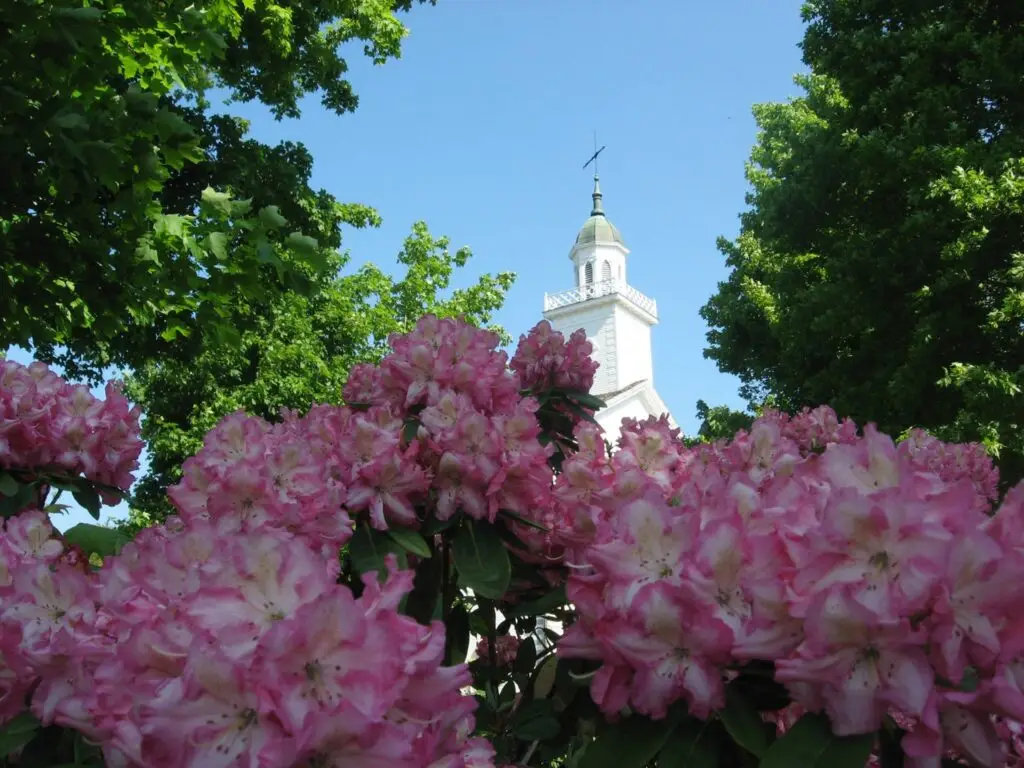
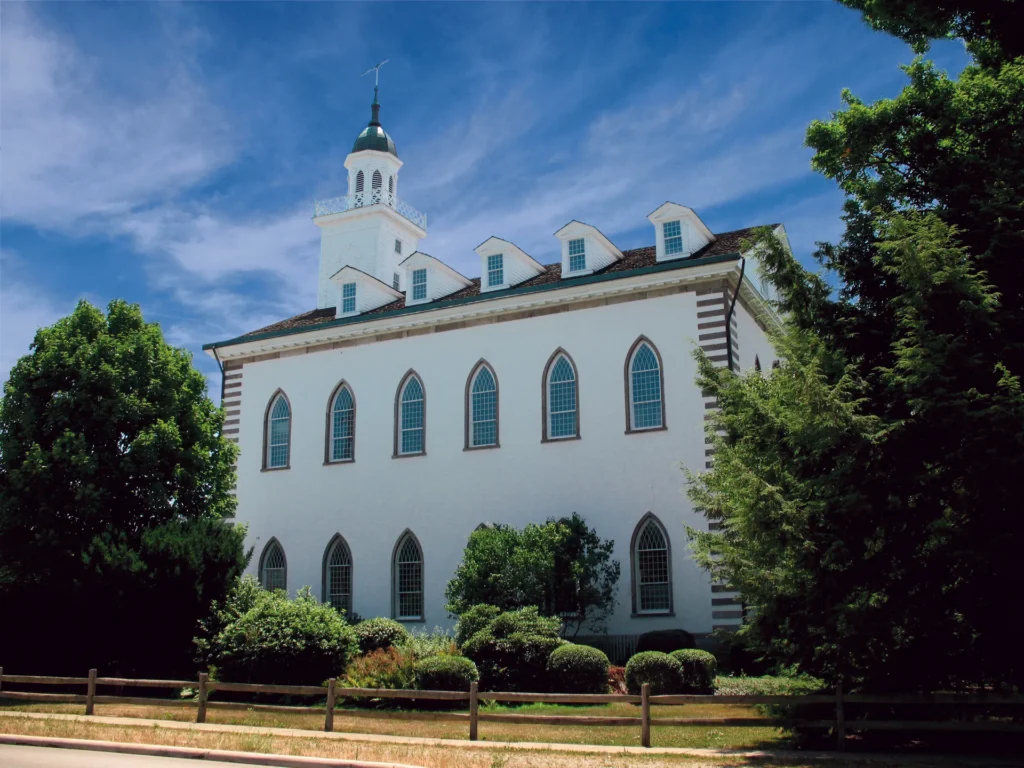
The iconic spire of the Kirtland Temple has watched over northeastern Ohio for nearly two centuries. The bell tower rises from a rectangular plan with a centered, prominent presence, visible for miles across the valley. The original finial that once crowned that spire now rests inside the Visitors’ Center, having been replaced with a reproduction in 1993.
The Glittering Walls
The exterior walls of the Kirtland Temple have a remarkable quality that most visitors notice the moment sunlight strikes them. Crushed glassware was mixed into the original stucco, making the walls appear to glisten. The Saints donated their own glass and pottery — ground fine and pressed into the mortar — as a personal offering to the Lord’s house.
On a clear Ohio morning, standing on the grounds and watching the sunlight move across those walls is one of the quieter, more remarkable things you can experience at Kirtland.
The temple was not originally white — it was a bluish-gray color. The roof was likely red, and the front doors were olive green. Today, only the doors are still their original color.
"That all people who shall enter upon the threshold of the Lord's house may feel thy power, and feel constrained to acknowledge that thou hast sanctified it, and that it is thy house, a place of thy holiness."
— Joseph Smith, dedicatory prayer of the Kirtland Temple, March 27, 1836
The Gardens and Grounds
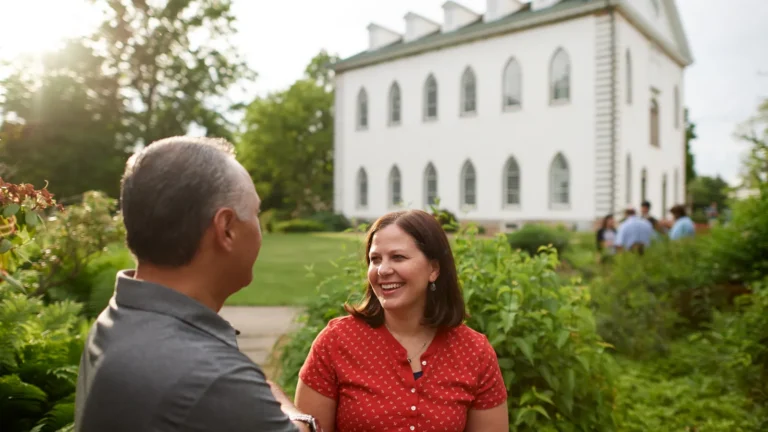
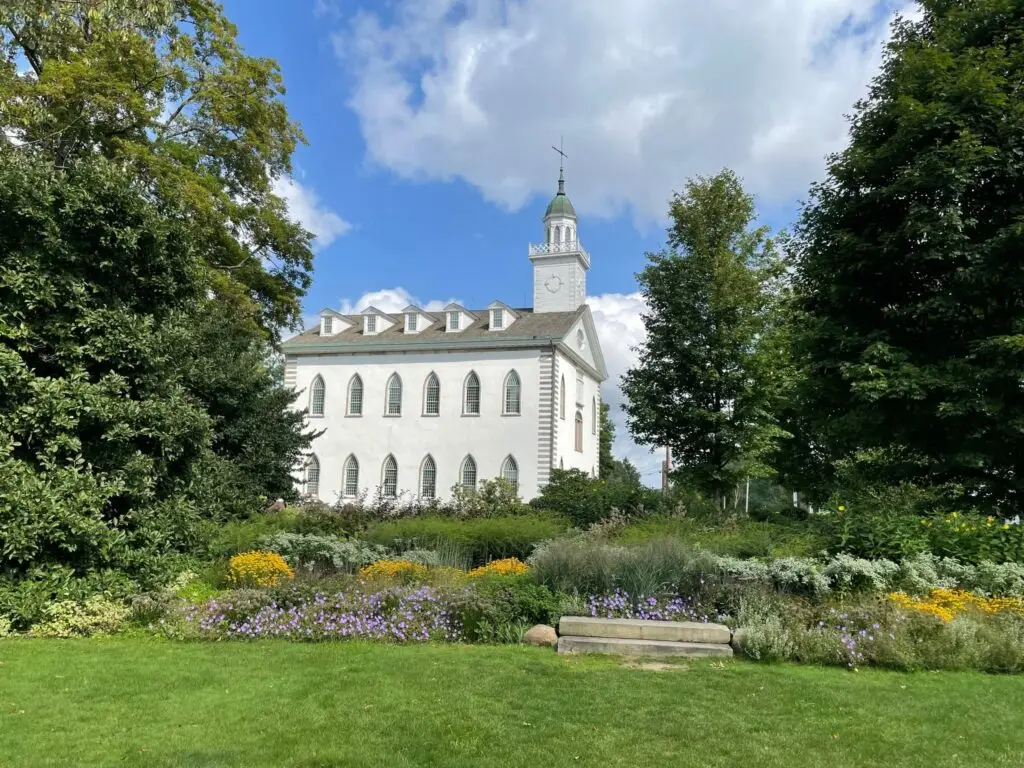
Beautiful, expansive, and meticulously maintained—the lawns and gardens surrounding the temple create a peaceful sanctuary of native hardwoods, seasonal plantings, and quiet paths along the hillside.
The Exterior Architecture
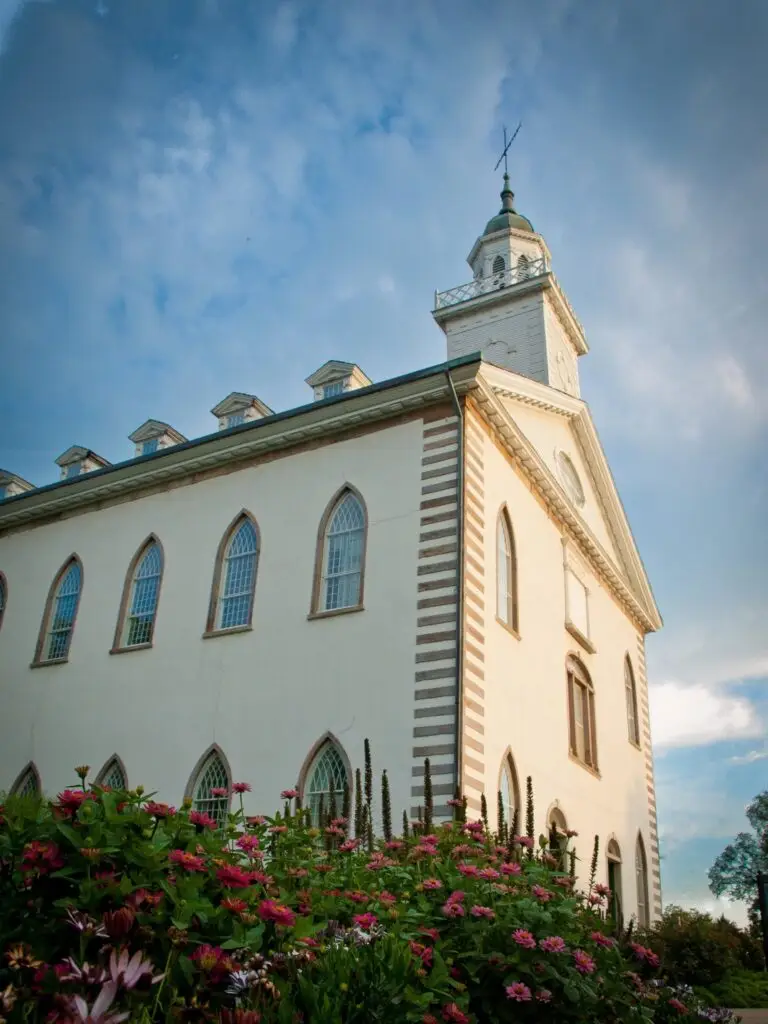
The temple is a blend of classical and Gothic Revival styles, typical of period houses of worship and reflecting the New England roots of its builders.
Gothic Arched Windows
Twelve tall arched windows grace each side elevation of the temple, a defining feature of the Gothic Revival influence that gives the building its distinctive silhouette.
The Oculus Window
The pedimented front gable features an oculus window, a circular eye centered above the twin entry doors and the great oversized multipaned window below it.
The Dormers
Five dormers on each side of the gabled roof display a Greek fret pattern with pedimented gables, a detail drawn directly from Asher Benjamin.
More to Discover
Joseph and Emma Smith Home
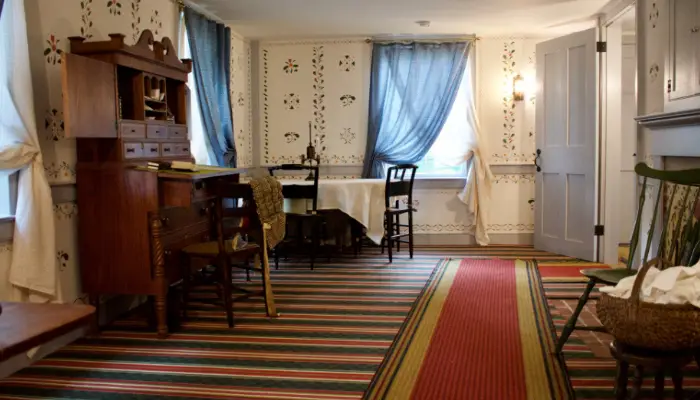
As construction began on the temple, Joseph and Emma Smith moved their family to their own home on the hill near the temple.
Historic Kirtland
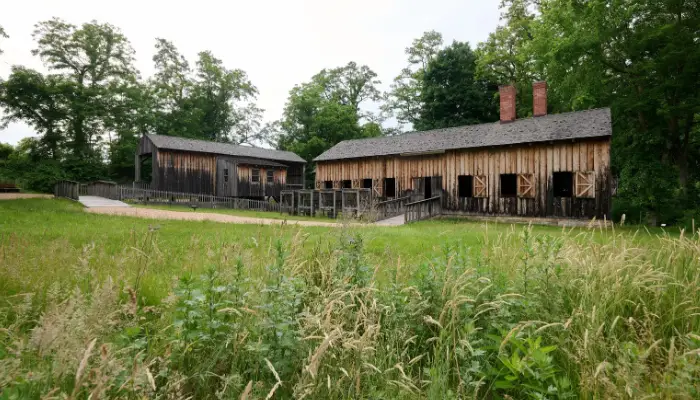
Roads have been narrowed and curbs removed to more closely resemble the appearance of early Kirtland, making the entire town feel like a step back in time.
The Sandstone Quarry
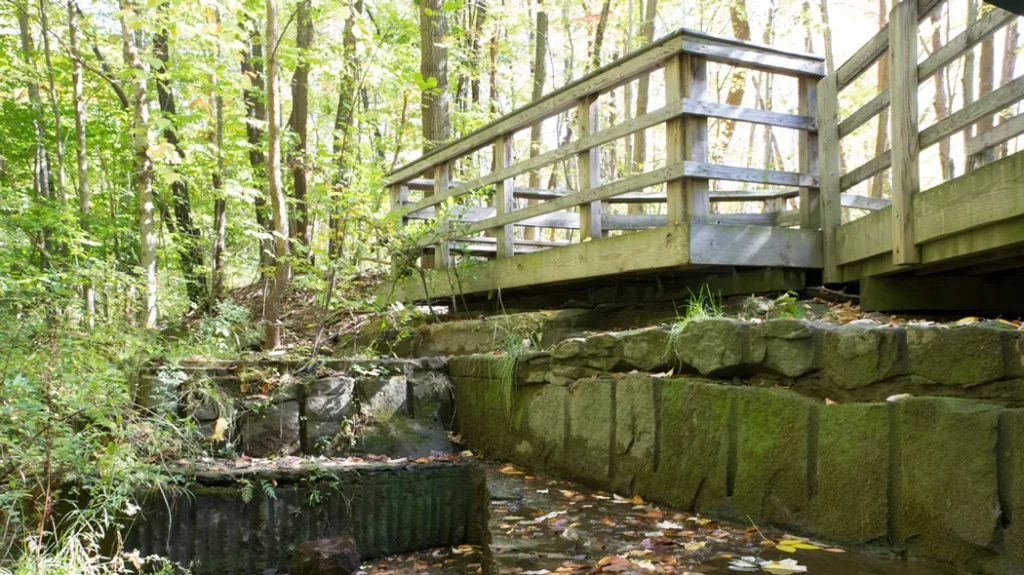
The sandstone in the temple’s walls was cut from a quarry south of the temple and hauled up the hill by ox team—among the heaviest labor of the entire project, given by Saints who had “hardly a plow that could be obtained.”
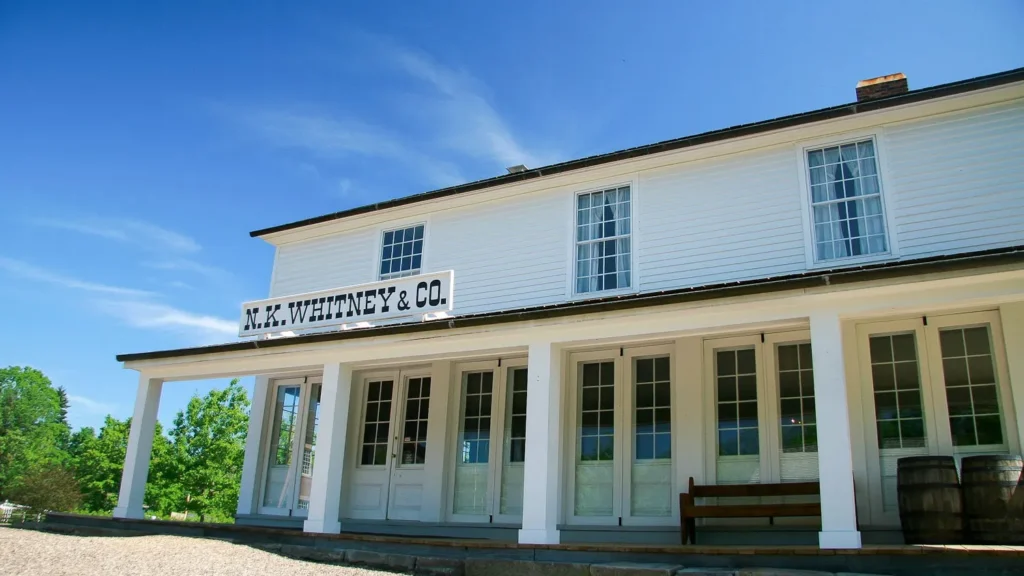
N. K. Whitney & Co. Store
A historic store that used to serve as the neighborhood grocery and supply shop.
Capture the Beauty
The temple grounds are among the most photogenic historic sites in Ohio. Photography is welcome throughout the grounds and exterior.
Words and photos can only capture so much. Come experience nearly two centuries of history, sacrifice, and sacred ground for yourself, open every day, always free.